
Sometimes the heart does not want romance, attraction, or promises. Sometimes it just wants someone’s presence back — the conversations, the comfort, the feeling of being understood. When a person leaves your life quietly, the pain does not scream; it sits silently and grows.
Islam never tells a broken heart to stay silent forever. It teaches you to turn silence into dua.
The Difference Between “Lost Love” and “Someone Back in Your Life”
This title is different — and so is the method.
- Lost love dua focuses on passion and reunion
- Marriage dua focuses on commitment
- Divorce dua focuses on mercy
But bringing someone back into your life is about:
- Emotional reconnection
- Removal of coldness
- Healing silence
- Comfort and familiarity
That is why this dua is gentle, slow, and emotionally aligned — not intense.
When This Dua Is Truly Appropriate
This dua is suitable if:
- The person drifted away emotionally
- Communication faded without closure
- Ego or silence created distance
- Life circumstances separated you
- You miss the bond, not the control
If your heart says “I just want peace with them again”, this dua matches that intention.
A Quranic Truth About Broken Connections
Allah reminds us:
“Allah is Gentle with His servants.”
— Surah Ash-Shura (42:19)
Gentleness is the core of this dua. Hearts do not return through pressure. They return when Allah places softness where hardness existed.
The Heart-Touching Quranic Dua
This dua is deeply emotional and often recited during personal hardship.
“Hasbiyallahu la ilaha illa Huwa.”
(Surah At-Tawbah 9:129)
Meaning:
“Allah is sufficient for me. There is no deity except Him.”
This dua works on emotional surrender — when you stop holding the pain tightly and place it in Allah’s care.
A Soft, Heart-Focused Wazifa
This wazifa is intention-based, not number-heavy.
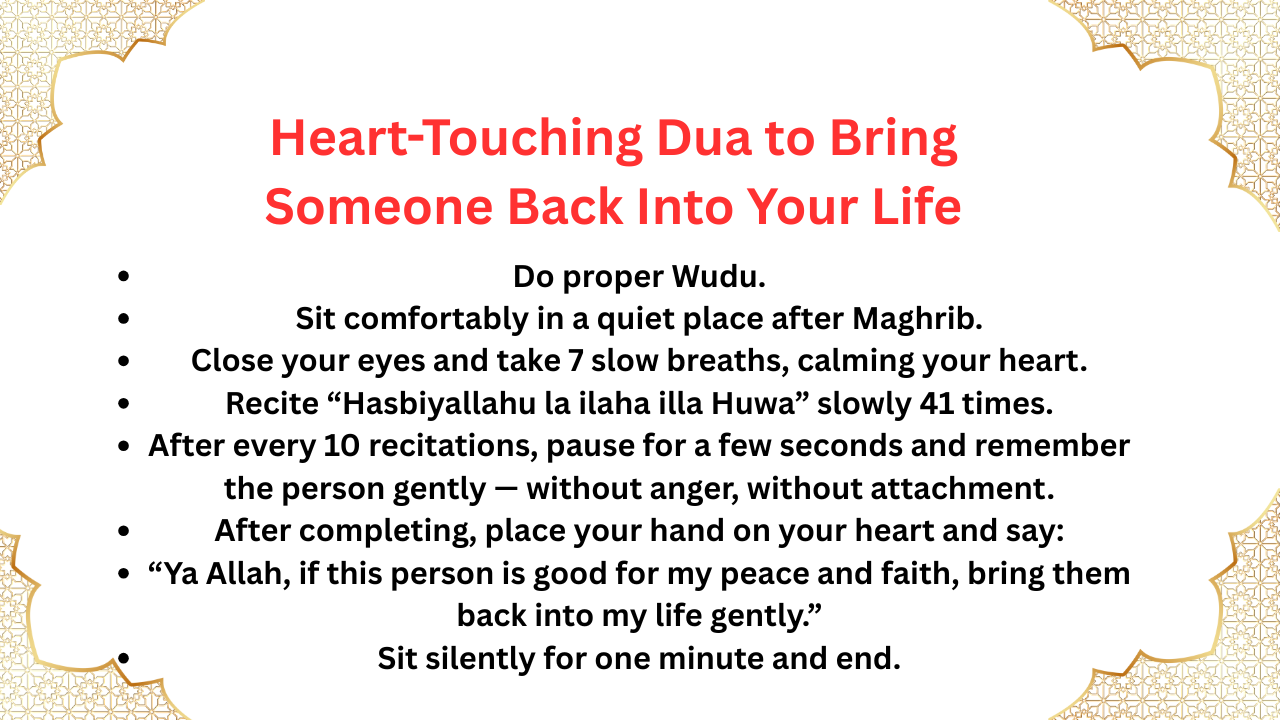
- Do proper Wudu.
- Sit comfortably in a quiet place after Maghrib.
- Close your eyes and take 7 slow breaths, calming your heart.
- Recite “Hasbiyallahu la ilaha illa Huwa” slowly 41 times.
- After every 10 recitations, pause for a few seconds and remember the person gently — without anger, without attachment.
- After completing, place your hand on your heart and say:
“Ya Allah, if this person is good for my peace and faith, bring them back into my life gently.” - Sit silently for one minute and end.

Do this for 11 consecutive days.
No rushing. No expectations.
Related Post:- Dua to Bring Someone Back Into Your Life
Heart-Touching Wazifa Flow
| Phase | Action | Focus | Duration |
|---|---|---|---|
| Preparation | Wudu + calm sitting | Emotional readiness | 2–3 min |
| Recitation | Hasbiyallahu | Surrender | 41 times |
| Reflection | Silent pauses | Soft remembrance | Short |
| Dua | Hand on heart | Peaceful intention | 1 min |
| Continuity | Daily practice | Emotional healing | 11 days |
What This Wazifa Heals First
Before situations change, Allah heals you:
- The heaviness in the chest reduces
- Emotional tightness loosens
- Memories stop hurting sharply
- Silence feels calmer
This is not loss — this is inner recovery.
Why Soft Duas Work Better Here
When someone left quietly, their heart closed quietly too.
A loud, forceful wazifa creates resistance.
A soft dua creates remembrance.
People often reconnect not because they were chased — but because they felt emotional safety again.
Related Post:- Dua to Get Your Lost Love Back Permanently
Realistic Outcomes (Emotion-Based)
This dua may lead to:
- Unexpected calm conversation
- Gentle reconnection
- Mutual closure with peace
- Or renewed presence if written
Every outcome brings healing — even if it looks different from what you imagined.
What NOT to Do During These 11 Days
- Do not stalk or monitor them
- Do not send emotional messages
- Do not replay old arguments
- Do not beg Allah with desperation
Dua is strongest when dignity remains intact.
A Quiet Truth
Sometimes Allah brings people back.
Sometimes He brings your heart back to life.
Both are mercy.
Sometimes the hardest part of making dua is not asking — it is accepting how Allah answers. In Part 1, we focused on softening the heart, surrendering pain, and reconnecting emotionally. Now, Part 2 is about what happens after the heart softens.
Because real dua does not end at recitation.
It continues in behavior, patience, and trust.
A Second Quranic Dua for Reconnection and Mercy
This dua is taken from the Quran and is deeply connected to relationships, distance, and emotional gaps.
“Rabbana hab lana min azwajina wa dhurriyyatina qurrata a’yunin.”
(Surah Al-Furqan 25:74)
Meaning:
“Our Lord, grant us from our relationships comfort to our eyes.”
This dua does not demand return.
It asks for comfort — whether through reunion, clarity, or peace.
Simple Mercy-Based Wazifa
This wazifa is done without visualization, only with calm presence.
- Perform Wudu.
- Sit after Isha prayer in a relaxed position.
- Recite Durood Sharif 3 times.
- Recite the above Quranic dua 21 times, slowly.
- After recitation, say only once:
“Ya Allah, bring comfort back into this connection if it is good for us.” - End with Durood Sharif 3 times.

Continue for 14 days.
That’s it.
No names, no photos, no force.
Mercy-Based Wazifa Structure
| Step | Action | Inner Focus |
|---|---|---|
| Start | Wudu + calm sitting | Readiness |
| Opening | Durood Sharif | Blessings |
| Core | Quranic dua (21x) | Mercy |
| Intention | One personal line | Trust |
| Ending | Durood Sharif | Closure |
If the Person Starts Reconnecting
If you notice:
- A message
- A call
- A soft reply
- A friendly gesture
Do not rush.
Islamic wisdom teaches:
- Respond with calm
- Speak less, listen more
- Do not reopen old wounds immediately
Let the reconnection breathe.
If the Person Does NOT Return
This is equally important.
Sometimes Allah answers by:
- Removing emotional dependency
- Healing obsession
- Restoring self-respect
- Preparing space for better people
A healed heart is also an answered dua.
Why Allah Sometimes Delays Reunion
Allah delays not to punish, but to:
- Change timing
- Mature emotions
- Remove ego
- Protect future pain
What comes back too early often breaks again.
A Common Mistake People Make
They stop dua the moment they feel relief.
But relief is not the end — it is the beginning of clarity.
Continue the wazifa even if:
- You feel lighter
- You feel calm
- You stop missing intensely
That means it’s working internally.
Emotional Signs the Dua Is Working
These signs appear before physical outcomes:
- Less anxiety about the person
- Reduced urge to check on them
- More acceptance
- Emotional stability
These are not losses.
They are strength.
FAQs
Q1. What is a heart-touching Islamic dua to bring someone back into your life?
A. A heart-touching Islamic dua to bring someone back is a sincere supplication asking Allah to soften hearts, restore affection, and guide the relationship back on the path of mercy, understanding, and respect.
Q2. Can sincere dua help someone return to your life?
A. Yes, sincere dua combined with patience, trust in Allah’s wisdom, and respectful behavior can spiritually support healing and reconciliation between hearts.
Q3. When should I recite this dua for best results?
A. The best times to recite this dua include after Fajr and Isha prayers, during Tahajjud, or anytime your heart is humble and focused on Allah’s mercy.
Q4. Should I combine this dua with good actions and communication?
A. Yes, pairing sincere dua with respectful communication, patience, kind behavior, and positive effort strengthens the practical side of reconciliation.
Q5. Is it permissible in Islam to ask Allah to reunite hearts?
A. Yes, Islam encourages asking Allah for what is good — including love, harmony, understanding, and reconciliation — when intentions are pure and within halal boundaries.


Leave a Reply